
Visit of the Chargé d’Affaires of the Embassy of the United States of America to the Montenegrin Orthodox Church
His Beatitude the Archbishop of Cetinje and Metropolitan of Montenegro, Mr. Mihailo, together with his associates and members of the Supreme Council of the Montenegrin Orthodox Church, received today at the Episcopal Palace in Cetinje Mr. Michael Keays, Chargé d’Affaires ad interim at the Embassy of the United States of America in Podgorica, as well as Ms. Milena Labović, Political-Economic Assistant at the Embassy, and Ms. Jessica Rice, Embassy officer responsible for monitoring religious affairs in Montenegro. The visit is part of regular consultations with religious communities in the context of preparing the annual State Department Report on International Religious Freedom.The idea of the independence of the Montenegrin Orthodox Church is as old as the struggle for the independence and freedom of Montenegro itself. The Church and the state have been inseparable throughout Montenegrin history, and the autocephaly of the Church has always been a prerequisite for the full independence of the state.
His Beatitude acquainted the guests with the historical foundations of the CPC as an autochthonous, autocephalous and canonical successor of the historical Montenegrin Orthodox Church, abolished by a non-canonical occupying decree on 14 July 1920, emphasising that the Montenegrin people and their Church, together and through the centuries, built the freedom, independence and spiritual identity of the state of Montenegro.
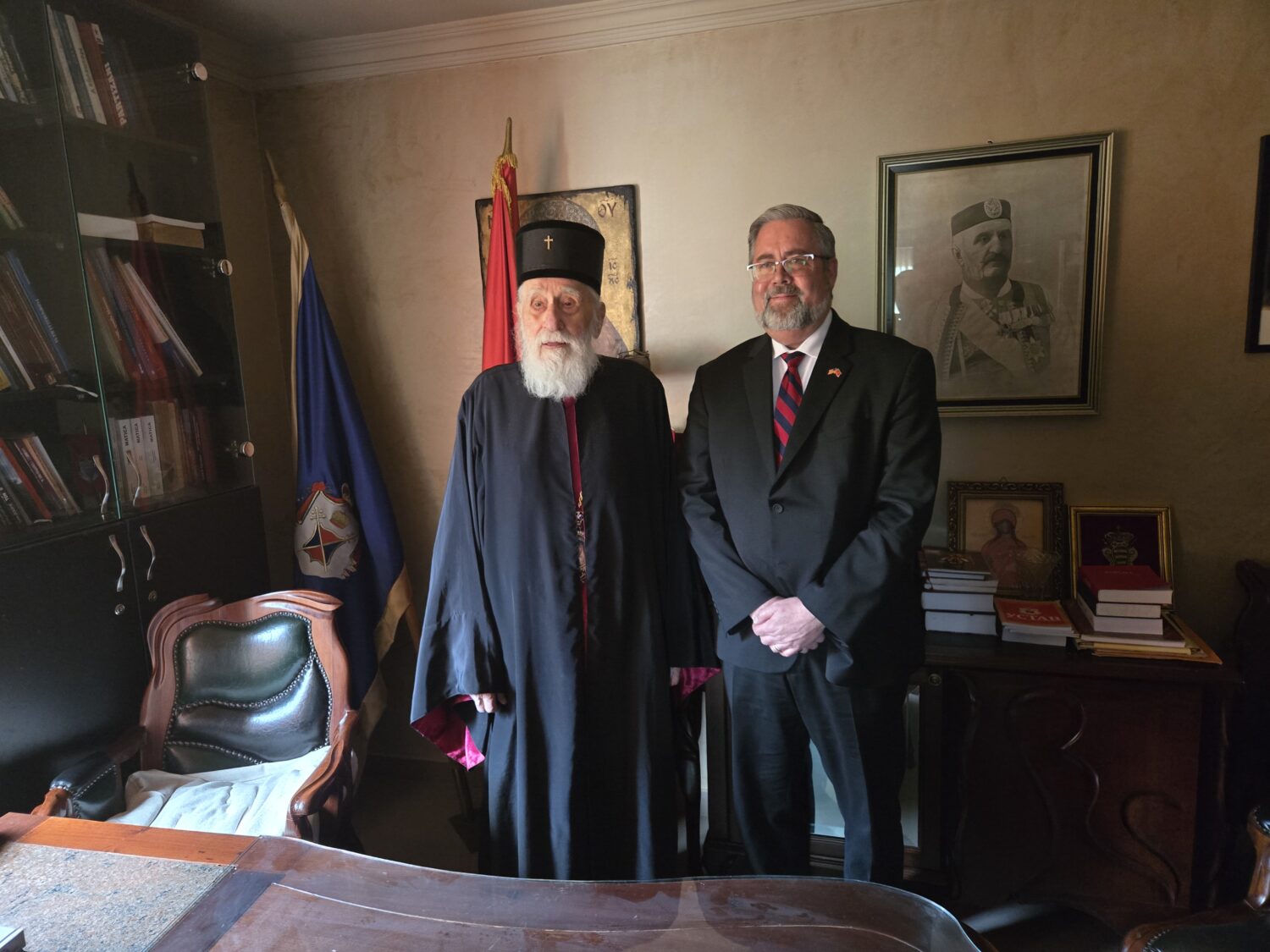
During the conversation, the guests were informed that the position of the Montenegrin Orthodox Church is extremely unfavourable. No Basic Agreement of equivalent content has been concluded with the CPC as has been with the Serbian Orthodox Church, although the constitutional principle of equality of religious communities under Article 14, paragraph 2 of the Constitution of Montenegro does not permit such an unequal relationship. Within the state, contrary to the Constitution and the law, an artificial distinction is made between so-called “traditional” churches and other religious communities, despite the fact that the positive legal order of Montenegro does not recognise such a category.
Attention was drawn to the unequal access to resources, contrary to Protocol No. 12 to the European Convention on Human Rights and Fundamental Freedoms, which prescribes a general prohibition of discrimination. This concerns the non-transparent and discriminatory exercise of discretionary powers in the distribution of budgetary funds and land parcels, at both the state and local levels, as well as by public enterprises, in favour of the Serbian Orthodox Church and to the detriment of the CPC and other religious communities.
Particular emphasis was placed on the harmful foreign influence exerted through the cross-border dioceses of the Serbian Orthodox Church and the Russian Orthodox Church on the territory of Montenegro. This influence undermines the constitutional order, the sovereignty of the state, NATO membership and Montenegro’s European path, serving as a channel for the dissemination of anti-European, anti-Atlantic and pro-Russian narratives under the guise of religious activity.
The autocephaly of the Montenegrin Orthodox Church in this regard represents a prerequisite for depoliticisation, for halting the instrumentalisation of the church for political purposes and the destabilisation of Montenegro. A pluralistic Orthodox environment, in which the CPC holds an equal institutional position, narrows the space for monopoly, hybrid influence and the political abuse of Orthodoxy.
The Montenegrin Orthodox Church does not seek privileges. It seeks equality in access to resources and public goods, in concluding agreements with the state, and in exercising its rights according to European standards, as required by the constitutional order of Montenegro and the legal acquis of the European Union.
Mr. Keays, a long-standing professional diplomat with over 33 years of service, emphasised that his mission is to help ensure that relations between the United States and Montenegro are the best they can be, and that this includes supporting Montenegro to be a strong state capable of defending itself and contributing to the NATO Alliance, a state that is economically prosperous and whose citizens are satisfied, as well as a state with a responsible government that serves its citizens and supports them in exercising their rights and freedoms. He recalled that the United States publishes an annual Report on International Religious Freedom, and that his visit is part of efforts to ensure that the report is complete and truthful.
His Beatitude expressed gratitude that the representatives of the U.S. Embassy carefully noted all the issues raised and showed openness to accept the written documents and factual materials presented to them by the Montenegrin Orthodox Church.
Cetinje, 14 May 2026
Public Relations Office