
TIMEKEEPER: THREE DECADES OF NJEGOŠ’S MAUSOLEUM – EXTINGUISHING THE “SERBIAN CANDLE”
Written by: Veseljko KOPRIVICA, Monitor January 3, 2007
Metropolitan Amfilohije and his diverse logistics, primarily in the form of Serbian parties from Montenegro, after Rumija are embarking on a new militant campaign: destination Lovćen.
The spokesperson of the Serbian People’s Party, Dobrilo Dedejić, announced: “After placing the small church on Rumija, we hope for the return of the chapel to Lovćen.”
“It would be the crown of Montenegro’s transformation and the crown of Montenegro’s return to its true historical path and to the historical code created for Montenegro by the Petrovićs, Balšićs, Crnojevićs, and Nemanjićs,” Dedejić enthuses, intoxicated by lessons from the Greater Serbian historical textbook.
It’s not impossible that his hope will be realized. The Montenegrin authorities hesitate to interfere in their own business: to protect the state by law. In the specific case, to stop the provocative actions of the aggressive Serbian Orthodox Church with appropriate regulations.
However, while the authorities decide to stop haggling with Amfilohije about respecting the laws of the state of Montenegro, let’s recall how and why the chapel was removed from Lovćen and who has been demanding its return to the symbol of libertarian Montenegro for decades.
Three decades ago, on July 28, 1974, the mausoleum of the Montenegrin poet, philosopher, and statesman Petar II Petrović Njegoš, the work of Croatian sculptor Ivan Meštrović, was solemnly opened on Lovćen.
The path to the moment when the granite word of our time merged with Njegoš and Lovćen was not easy at all, reminded Veljko Milatović, then president of the Presidency of the Socialist Republic of Montenegro. And from the Lovćen peak he warned:
“To love Njegoš, to live with him and receive his poetic and moral messages about life and freedom, to build upon and extend the life of his truths, it is necessary to return him to authenticity and originality, we are obliged to free the interpretation of his work, poetic and statesmanlike, from the ballast of romantic and folkloric naivety, Orthodox and bourgeois mythomania, and decor for an ephemeral national drama and pathos.”
How much has been achieved in this regard in the meantime is a topic for competent experts, but part of the answer to that question can be found in this reminder of some of the actors who opposed the construction of the mausoleum and those who later, up to the present day, strived to demolish it.
Anticipating his imminent death, Njegoš left a testament on October 5, 1851: “I want you to bury me in that church on Lovćen.”
His wish was fulfilled, but in 1916, Austro-Hungarian artillerymen destroyed the church. There are many documents about this, and in the minutes of November 19, 1920, from the Holy Synod, the highest body of the Serbian Orthodox Church, signed by Serbian Patriarch Dimitrije and thirteen bishops, it states: “His Grace Metropolitan Gavrilo reports that the enemy occupation authorities destroyed the Chapel and tomb on Lovćen, and removed the bones of Bishop Rade from the tomb and took them down to Cetinje at night.”
Falsifiers of Montenegro’s past regularly overlook the fact that the mausoleum was not placed instead of the authentic chapel where Njegoš was buried, but on the site of the church built by King Aleksandar Karađorđević, following a proposal made precisely at the mentioned session of the Holy Synod of the SPC. The church, as King Aleksandar’s endowment, as evidenced by the inscription on it, was completed in September 1925. Njegoš’s relics were transferred to it, and the great national celebration was attended by the King Unifier himself, who was so beloved among Montenegrins that they had prepared an assassination attempt for his reception.
Two decades later, the Committee for the Celebration of the Centenary of Njegoš’s Death (1951) decided to erect a monument to Njegoš.
The Montenegrin authorities reached an agreement with sculptor Ivan Meštrović, who lived in America and was the author of two famous monuments in Serbia – on Avala and Kalemegdan. For a fee of “a wheel of Njegoš cheese and prosciutto.” Meštrović accepted the offer. And in September 1957, Njegoš’s statue weighing 28 tons arrived in Cetinje, two years later two huge caryatids were delivered, and excavation of the tunnel under the Lovćen peak began…
Parallel to the construction work, a polemic flared up, especially during 1966, lasting until mid-1971, about whether to place Meštrović’s mausoleum on Lovćen or in Cetinje, or whether to demolish the church on Lovćen or preserve it. It was, in fact, a verbal war between defenders of Montenegro and everything Montenegrin against a strong front of Greater Serbian intellectuals and politicians who believed they had an eternal deed to decide on everything and anything happening in Montenegro.
Part of the polemics and reactions was collected in Lazar Trifunović’s book “Twilight of Lovćen.”
In the early nineties, “Pobjeda,” then widely known for stoking “patriotic journalism,” published excerpts from it along with the positions of numerous intellectuals from Serbia and Montenegro on the fate of the mausoleum, under the title “The Cry of Lovćen.”
Dr. Niko Martinović, director of the Library in Cetinje, was one of those who spoke against building the mausoleum on Lovćen. He advocated “for Njegoš’s modest vow, for respecting his wish.”
To this, the Expert Collegium of the Cetinje Museum reminded the director of the historical truth: “Today’s small church and tomb, to which he wants to attach Njegoš’s testament, was built in 1925 by King Aleksandar. And that means that he, like all those who share his opinion, advocates for Aleksandar’s small church as Njegoš’s testament.”
Serbian academician Ljubomir Durković Jakšić, who dealt with Njegoš’s work and is known for falsifying historical facts about the Montenegrin Orthodox Church, said: “To demolish that chapel means to carry out the deed that the enemies did not succeed in doing.”
He would, in the early nineties of the last century, when Greater Serbian nationalists set out to dismantle Njegoš’s mausoleum, cry out: “By demolishing the chapel on Lovćen, the Serbian candle was extinguished.”
Interestingly, this thought runs as a leitmotif through the statements of almost all those who lived for the day when King Aleksandar’s chapel, where Njegoš once rested, would be returned to the Lovćen peak.
The most fervent opponents of building the Mausoleum on Lovćen were intellectuals from Belgrade, originally from Montenegro. Among the signatories of their letter was also writer Mihailo Lalić.
In a telegram, he told them: “I give my signature, I don’t hope for success.”
Academician Vladimir Dedijer, one of the participants in the polemic about the Mausoleum and a member of the Committee for the Construction of the Mausoleum, wrote in Belgrade’s “Borba” on August 20, 1970:
“The hierarchy of the Serbian Orthodox Church is not conducting a campaign to preserve Njegoš’s legacy, but is straining all forces to save King Aleksandar Karađorđević’s building… I joined the Committee for the construction of Petar II Petrović Njegoš’s mausoleum on Lovćen because I want to defend historical truth and want to raise my voice against dictating what Montenegrins may and may not do.”
Dr. Pavle Ivić, one of the fiercest Serbian opponents of the construction of the Mausoleum on Lovćen, defended his position thus:
“The aesthetic failure of the monstrous building on the mutilated mountain, the monstrosity of the idea that the grave for the greatest Serb among Serbian poets should be enthroned by the creation of a man blinded by hatred of the Serbian people.”
At the end of January 1969, the Assembly of Cetinje Municipality made an official decision to build the Mausoleum on Lovćen “interpreting the wishes of Yugoslavs, and especially Montenegrins and residents of Cetinje Municipality.”
The Holy Synod of the Serbian Church reacted swiftly and aggressively to this. The embittered delegates of the Cetinje Municipality Assembly responded to the Synod. Due to the identification of the Assembly’s decision with the barbaric act of the Austro-Hungarian occupier who demolished Njegoš’s chapel in 1916, it was proposed that satisfaction be sought from the Synod through legal means, but also the resignation of the Cetinje Metropolitan. Even Cetinje high school students organized demonstrations, carrying a banner “We want a monument on Lovćen.”
However, the Metropolitanate of Montenegro and the Littoral, as an extension of the Serbian Church and Belgrade, did not give up. They filed a lawsuit against the Republic of Montenegro with the Constitutional Court, and then sued Montenegro and Cetinje Municipality in the District Court in Titograd. Surprisingly, both lawsuits were rejected.
The Mausoleum was built, but its opponents did not give up. Every so often they set out to demolish it, and they were especially eager to do so in the early nineties, during wartime, hoping that leader Slobodan Milošević would restore at least part of Dušan’s empire. They lamented for the unification of all Serbian lands and Kosovo, tried to relight the “extinguished Serbian candle” on the Lovćen peak by demolishing the Mausoleum and returning the king’s chapel, which they called Njegoš’s.
Serbian writer Dobrica Ćosić encouraged them with an extraordinary move: he bequeathed the monetary part of the Njegoš Prize, a prestigious literary award in former Yugoslavia, for the demolition of Njegoš’s mausoleum!
In the mentioned brochure “The Cry of Lovćen,” Serbian Patriarch Pavle also says that by demolishing “the small church of St. Peter of Cetinje, the Montenegrin authorities extinguished the Serbian Orthodox candle on Lovćen,” but, as a kind of testament, he conveys to his flock:
“After this act committed by the authorities of SR Montenegro, the Cetinje Metropolitanate, the Holy Synod of the Serbian Orthodox Church, and the entire Serbian Orthodox Church have constantly strived to restore the Church of St. Peter of Cetinje on Lovćen in the same place, of the same shape and size as it was, and to return the earthly remains of Bishop Petar II Petrović Njegoš to it. This remains the case today.”
It would be a surprise if the militant SPC changed its mind.
The Metropolitan of the Serbian Church in Cetinje also admits that he sits on it with the intention of returning the chapel to Lovćen: “The temple must be returned. The roof must be returned to Montenegro. Montenegro was left without a roof. What kind of master will live in a house without a roof? Except someone who has lost their mind.”
“If the chapel had been a place of worship of any other faith, I am convinced it would not have been demolished. It was demolished because it belonged to the Serbian Orthodox Church,” reveals Serbian poet and occasional politician Matija Bećković.
Dr. Novak Kilibarda supports this idea: “The monument, experts say, can be disassembled without much effort, and the statue should be placed in a suitable place or given to an environment that agrees with Meštrović’s vision of Njegoš.”
Serb Kilibarda explains to Montenegrins: “In short, whoever prefers Meštrović’s Mausoleum to Njegoš’s Chapel does not understand Kosovo’s sacrificial endeavor, nor the specificity of Montenegrin combative Orthodoxy, nor Serbian oral epic as an image of these ideological directions, nor Njegoš’s work as a synthesis of all this.”
Kilibarda was not yet in the Duklja Academy of Sciences and Arts at that time.
Serbian academician Dr. Veselin Đuretić, originally from Zeta, known for anti-Montenegrin statements, accusing Meštrović of pathological anti-Serbism, prophesies like a seer: “I clearly see a kilometers-long chain of people, stretching from Ivanova Korita to the Jezerski peak of Lovćen, how hand to hand they liberate the stone pile from ideological curse and how, returning it to its rightful place, they restore the spirit of a great historical and national symbol.”
When expressing support for the demolition of the Mausoleum, Serbian writer Danko Popović was exceptionally inspired:
“The vertical of the Serbian cross has been brought down! The roof of the Serbian homeland has been demolished, the threshold from which one could step from the Earthly to the Heavenly Kingdom, to Heavenly Serbia, has been dug up (the Serbian people had two states, two earthly empires, but the Heavenly Kingdom, Heavenly Serbia, was always common to all Serbs)! One should think about whether to embed one stone from each Serbian province into the restored chapel, or whether the stone that would mark the all-Serbian presence on Lovćen should be brought from the areas of great Serbian battlefields and martyrdoms.”
Academician Pavle Ivić, Dr. Nikola Milošević, Dr. Ljubomir Tadić, writer Miodrag Bulatović (“Meštrović’s chapel must go into oblivion or into the clouds, whether the devil or a man with a rod will move it”), Dr. Dragoljub Petrović (“Lovćen with Njegoš was the highest Serbian mountain, and without him it is little higher than any Njegoš head”), writer from Montenegro Dr. Jovan Čađenović, CANU academician Vlado Strugar, psychiatrist and writer Jovan Striković, publicist Komnen Bećirović, originally from Morača, who claims that “we Serbs live from Kosovo more by the heavenly than the earthly kingdom,” poet and politician Budimir Dubak, poet Gojko Đogo all voiced their support for the return of the chapel and removal of the Mausoleum.
“When Njegoš’s chapel reappears on Lovćen, it will be a great celebration in Montenegro and throughout all Serbdom,” Batrić Jovanović, former Montenegrin and Yugoslav politician, is certain. By the way, for him, the demolition of the church is “the misdeed of Montenegrin leaders, devoted vassals of the anti-Serbian coalition.”
Wondering how the chapel could have been removed from Lovćen at all, Radovan Karadžić, before becoming the leader of Bosnian Serbs and one of the most wanted fugitives in the world, meditated: “I will not speak about what was placed instead of the chapel, I only want to emphasize to what extent violence was committed against the last will of the poet and bishop, and thus against the entire people of Montenegro.”
Here are a few more “great thoughts” of famous personalities “originating from Montenegro” on the same topic.
Belgrade linguist Radmilo Marojević says that “only Njegoš’s temple and only Njegoš’s grave can be on Lovćen, and the marble from Lovćen should be taken down and assembled on the western border of Serbdom, on the boundary of the Montenegrin village of Peroj in Istria and the western winds.”
Poet from Veleta Dragomir Brajković claims that the story of Lovćen and Njegoš’s chapel is another in a series of unhappy tales about “our de-Serbianization and dehumanization,” and by returning the chapel “Cetinje would again be what it was a century and a half ago: a city toward which, with reason, all Serbdom turned its head.”
The demolition of the Mausoleum and the return of the king’s chapel was one of the most pressing tasks of the People’s Party while it was led by Novak Kilibarda.
The Initiative Committee for the Return of Njegoš’s Chapel to Lovćen issued a Proclamation that was read at a press conference, attended by the author of these lines, on October 24, 1990, at Hotel “Podgorica.” The conference was held by Komnen Bećirović and Budimir Dubak.
“The Serbian soul actually cries out for the return of the Chapel to Lovćen, just as Njegoš’s ashes cry out for his beautiful vowed temple, therefore we are approaching the establishment of an initiative committee for the restoration of the Lovćen peak and sanctuary, thus taking the first step toward the formation of an all-Serbian committee that would deal with the realization of this great undertaking,” the Proclamation states.
“Finally, if necessary, let a living human chain be made from Ivanova Korita to the Jezerski peak, so that hand to hand, stone by stone from the damaged Njegoš’s endowment would pass, so that the hand of a mason on the height would assemble it into what the Chapel with the Lovćen peak has always been for us: the highest soaring of our soul, the altar of generations, the flame of Serbdom and Orthodoxy, a sign of our human and national dignity, our permanence and our indestructibility,” the Proclamation reads at the end.
The Proclamation has 16 signatories. In first place is Komnen Bećirović, then Budimir Dubak, Momir Vojvodić, Bishop Nikanor Bogunović, Archpriest Momčilo Krivokapić, Dr. Novak Kilibarda, Dr. Vlado Strugar, Dr. Jovan Striković, Dr. Aleksandar Drašković, Miodrag Tripković, Ranko Jovović, Radomir Uljarević, Ratko Vulanović, Jovan Plamenac, Bećir Vuković, and finally Momir Čabarkapa.
In the brochure “The Cry of Lovćen,” published by “Pobjeda” in the early nineties, undated, there are about fifty statements by writers, clergy, politicians advocating for the demolition of Njegoš’s chapel. There are Patriarch Pavle, Amfilohije, Matija Bećković, Veselin Đuretić, Rastislav Petrović, Ljubomir Tadić, Miodrag Bulatović, Batrić Jovanović, Vlado Strugar, Radovan Karadžić, Vuk Krnjević, Jovan Markuš, Gojko Đogo, Budimir Dubak.
A photograph is published with each statement. Among them is Novak Kilibarda with a lengthy text. Kilibarda says:
“Returning Njegoš’s chapel to Lovćen implies the restoration of the Temple of St. Peter of Cetinje, respect for Njegoš’s decision to rest in an Orthodox church on Lovćen, and the obligation to restore Lovćen’s natural appearance. Enemies of Serbian Orthodoxy naively believed that by demolishing the temple with Njegoš’s ashes they would split his mission that he had already achieved.
What to do with Meštrović’s monumental sculpture, which undoubtedly has artistic qualities? The monument, experts say, can be disassembled without much effort, and the statue should be placed in a suitable place or given to an environment that agrees with Meštrović’s vision of Njegoš. In short, whoever prefers Meštrović’s Mausoleum to Njegoš’s Chapel does not understand Kosovo’s sacrificial endeavor, nor the specificity of Montenegrin combative Orthodoxy, nor Serbian oral epic as an image of these ideological directions, nor Njegoš’s work as a synthesis of all this.”
The brochure was published in 20,000 copies.
Now Kilibarda claims he was not for the demolition of the Mausoleum! And threatens those who remind him of it.
Thanks for asking, Njegoš’s mausoleum still stands firmly on the Lovćen peak, and Montenegrins have no intention of demolishing it.
NJEGOŠ DAY
Montenegro celebrated November 13, 2023, as Njegoš Day as an official state holiday. This was the first time that Montenegro marked Njegoš Day as a state cultural holiday.
On that day in 1813, Petar II Petrović Njegoš, Montenegrin bishop, poet, philosopher, and statesman, was born in Njegoši.
As a statesman, he laid the foundations of the modern Montenegrin state, established executive power and the Senate, organized courts, and introduced taxes. During his reign, the first printing press in Cetinje was established in 1834 and the first school was built.
Petar II Petrović Njegoš, one of the most significant figures in the history of Montenegrin literature and culture, died on October 19 according to the old calendar, and October 31 according to the new calendar, in 1851.
“The Ray of the Microcosm,” “The Mountain Wreath,” and “The False Tsar Šćepan the Small” are Njegoš’s most famous works. In addition to them, he wrote poems “The Montenegrin to Almighty God,” “Ode on the Birthday of the All-Russian Emperor Nicholas the First,” “The Captured Montenegrin by the Fairy,” “The Hermit of Cetinje,” “The Departure of Pompey”…
On the occasion of this holiday, many prominent creators spoke about Njegoš and his timeless work. University Professor Dr. Tatjana Đurišić, President of the Organizational Committee of the manifestation, spoke extraordinarily about Njegoš on TV Montenegro.
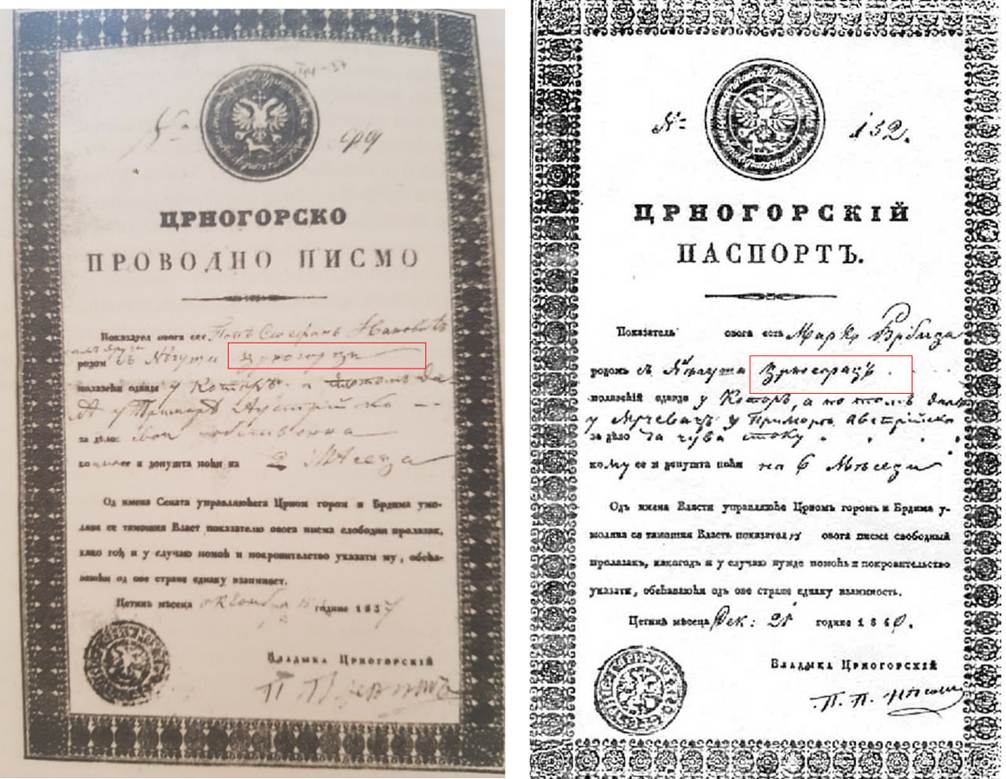
As a statesman, Njegoš laid the foundations of the modern Montenegrin state. If we look at passports from the period of Petar II Petrović Njegoš – the “Montenegrin Travel Document” or later the “Montenegrin Passport,” in both of these documents the nationality Montenegrin was entered. The passports were signed personally by Petar II Petrović Njegoš or the President of the Senate, because the “Montenegrin Passport” was issued by the Montenegrin Senate. Also, Njegoš used the term Montenegrin nation.
Many reminded that Njegoš was the first to utter the word Yugoslav, that he dreamed with Ban Jelačić of liberating Croats from the Austro-Hungarian monarchy, that he was blood brother with Ali Pasha Rizvanbegović and dedicated the most beautiful pages to Islamic civilization through the description of Istanbul… Understanding Njegoš as an Islamophobe is deeply wrong, and it was said that some Bosniak intellectuals such as Rusmir Mahmutćehajić have fallen into that trap.
Serbian Metropolitan Joanikije, originally from Banjani, also spoke out. “We will celebrate when Njegoš’s chapel returns to where it belongs,” said Serbian Metropolitan Joanikije at the cultural-spiritual manifestation “Njegoš Days” in the Parish House in Nikšić.
The coordinator of the Initiative Committee of the Montenegrin European Party, Novak Adžić, reacted to the new call by Serbian Metropolitan Joanikije Mićović for the chapel to be returned to Lovćen instead of the Mausoleum.
Adžić states that the Metropolitan of the Church of Serbia in Montenegro constantly misuses Njegoš, whose work he does not understand.
“He even considers him a saint, but he is not a saint, but was a Montenegrin ruler and head of the autocephalous Montenegrin Orthodox Church. And Joanikije still wants to return the occupier’s Aleksandar’s chapel. He won’t be able to,” Adžić wrote on Twitter.
From the Citizens’ Initiative “May 21” they announced:
“If Njegoš were to look back at the time we live in, there is no doubt that he would speak authentically and tell everyone as befits them. To Belgrade hegemonists and appropriators: ‘The nut is a hard and wondrous fruit, don’t break it but break your teeth.’ To nationalists throughout the former Yugoslavia: ‘Lipo, ljepo, lepo and lijepo, bilo, bjelo, belo and bijelo – are petals of one flower, blooming in one bud.’ To falsifiers of Montenegrin and Yugoslav historiography: ‘Self-deception is deadly for both people and nations.’ To the Serbian Orthodox Church: ‘I am God’s whip woven for you, to remind you of what you have done.’ To the Montenegrin government: ‘No one is happy, and no one is satisfied, no one is calm, and no one is peaceful. Man always shames himself with man. The monkey looks at himself in the mirror.’ To the Montenegrin opposition: ‘Fear often stains the face of life.’ To the average Montenegrin voter: ‘Fools are blind with eyes, who see but see in vain.’ To Montenegro: ‘Without suffering, a song is not sung, without suffering, a sword is not forged.'”