
The Montenegrin Orthodox Church Participated in the Preparation of the Revised Programme for Montenegro’s Accession to the European Union
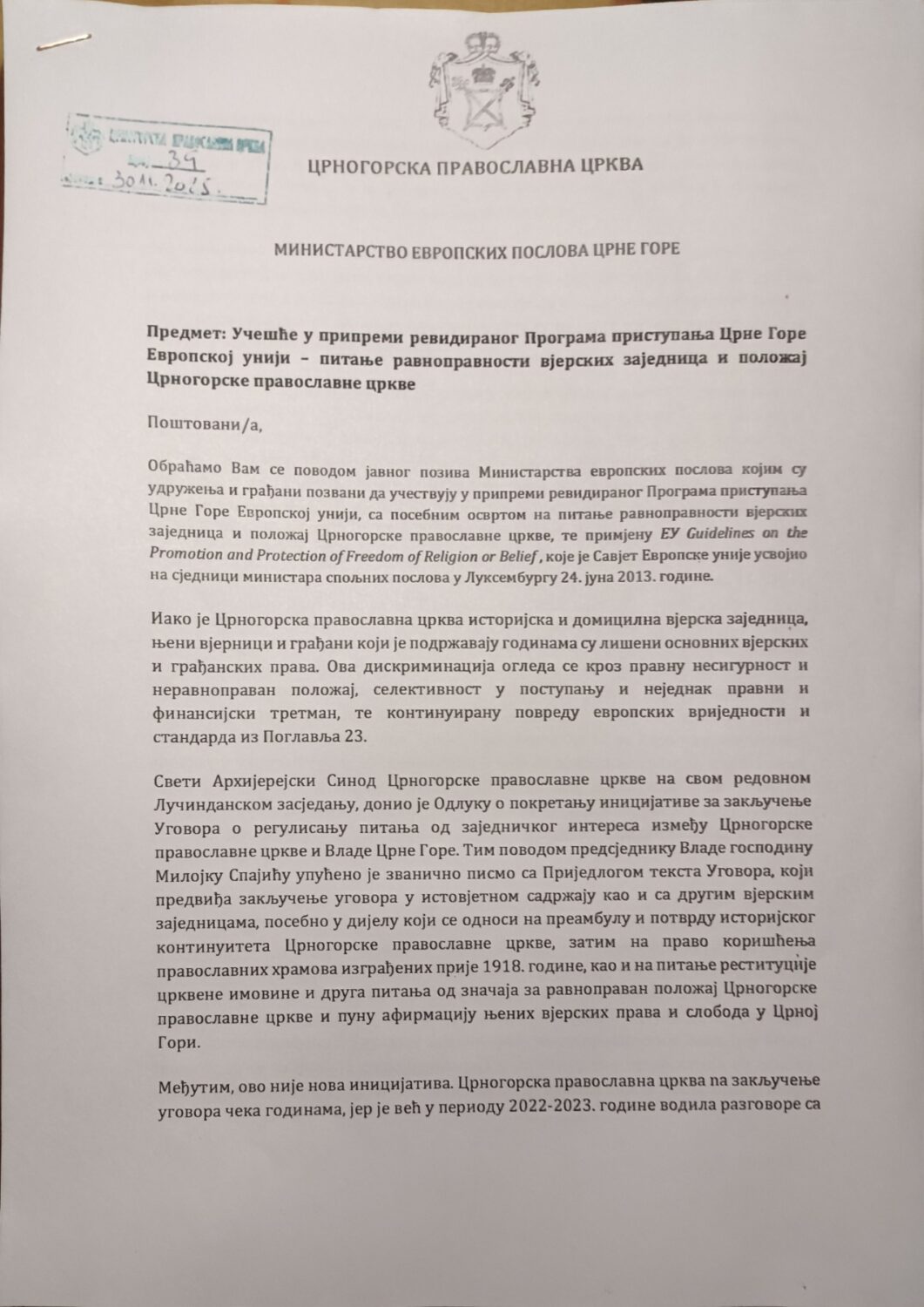
In response to the Public Call issued by the Ministry of European Affairs on 19 November 2025, inviting organs, organisations, associations, and individuals to participate in the initial phase of preparing the revised Programme for Montenegro’s Accession to the European Union, we hereby publish the Letter of His Eminence the Archbishop of Cetinje and Metropolitan of Montenegro, His Grace Mihailo, in its entirety.
***
MINISTRY OF EUROPEAN AFFAIRS OF MONTENEGRO
Dear Sir/Madam,
We are writing to you in response to the public call issued by the Ministry of European Affairs, inviting associations and citizens to participate in the preparation of the revised Programme for Montenegro’s Accession to the European Union, with particular reference to the issue of equality among religious communities and the position of the Montenegrin Orthodox Church, as well as the application of the EU Guidelines on the Promotion and Protection of Freedom of Religion or Belief, adopted by the Council of the European Union at the meeting of Foreign Affairs Ministers in Luxembourg on 24 June 2013.
Although the Montenegrin Orthodox Church is a historical and indigenous religious community, its faithful and the citizens who support it have been deprived of fundamental religious and civil rights for years. This discrimination is manifested through legal uncertainty and unequal status, selective treatment and unequal legal and financial treatment, as well as continuous violations of European values and standards under Chapter 23.
The Holy Synod of Bishops of the Montenegrin Orthodox Church, at its regular session on the Feast of Saint Luke, adopted the Decision to initiate a proposal for concluding an Agreement on the Regulation of Matters of Common Interest between the Montenegrin Orthodox Church and the Government of Montenegro. On this occasion, an official letter was sent to the Prime Minister, Mr Milojko Spajić, together with a Draft Agreement, which envisages the conclusion of an agreement identical in content to those concluded with other religious communities, particularly with regard to the preamble and the confirmation of the historical continuity of the Montenegrin Orthodox Church, the right to use Orthodox churches built before 1918, as well as the issue of restitution of church property and other matters relevant to the equal status of the Montenegrin Orthodox Church and the full affirmation of its religious rights and freedoms in Montenegro.
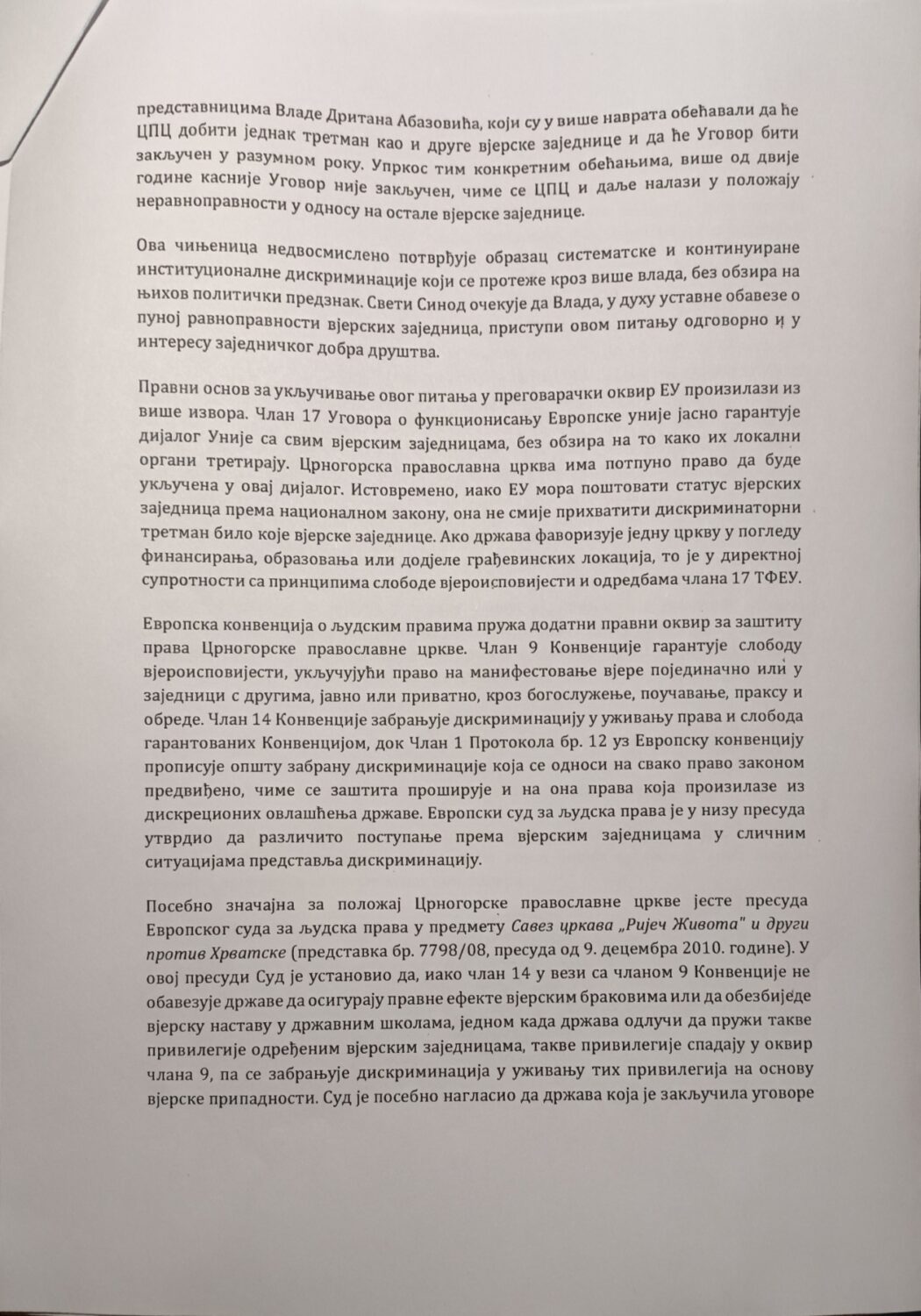
However, this is not a new initiative. The Montenegrin Orthodox Church has been waiting for the conclusion of an agreement for years, as it had already conducted negotiations with representatives of the Government of Dritan Abazović during the period 2022–2023, who on several occasions promised that the MOC would receive equal treatment as other religious communities and that the Agreement would be concluded within a reasonable timeframe. Despite these concrete promises, more than two years later, the Agreement has not been concluded, leaving the MOC still in a position of inequality compared to other religious communities.
This fact unequivocally confirms a pattern of systematic and continuous institutional discrimination that extends across multiple governments, regardless of their political orientation. The Holy Synod expects the Government, in the spirit of the constitutional obligation of full equality of religious communities, to approach this issue responsibly and in the interest of the common good of society.
The legal basis for including this issue in the EU negotiating framework derives from several sources. Article 17 of the Treaty on the Functioning of the European Union clearly guarantees the Union’s dialogue with all religious communities, regardless of how they are treated by local authorities. The Montenegrin Orthodox Church has every right to be included in this dialogue. At the same time, although the EU must respect the status of religious communities under national law, it must not accept discriminatory treatment of any religious community. If a state favours one church in terms of funding, education, or allocation of building sites, this is in direct conflict with the principles of freedom of religion and the provisions of Article 17 TFEU.
The European Convention on Human Rights provides an additional legal framework for the protection of the rights of the Montenegrin Orthodox Church. Article 9 of the Convention guarantees freedom of religion, including the right to manifest one’s religion individually or in community with others, in public or in private, through worship, teaching, practice, and observance. Article 14 of the Convention prohibits discrimination in the enjoyment of the rights and freedoms guaranteed by the Convention, while Article 1 of Protocol No. 12 to the European Convention prescribes a general prohibition of discrimination applicable to any right set forth by law, thereby extending protection to those rights arising from the discretionary powers of the state. The European Court of Human Rights has established in a series of judgments that differential treatment of religious communities in similar situations constitutes discrimination.
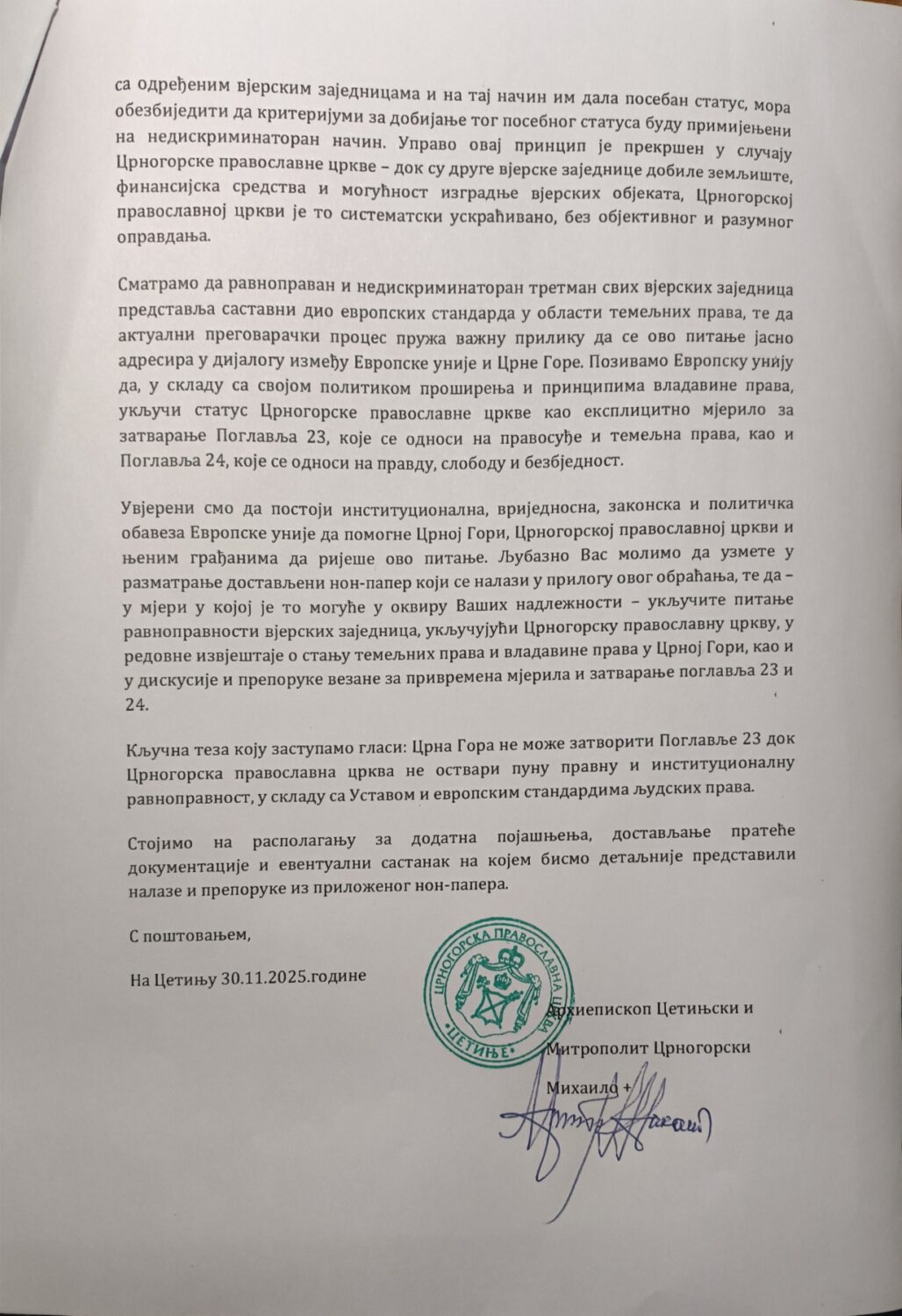
Of particular significance for the position of the Montenegrin Orthodox Church is the judgment of the European Court of Human Rights in the case of Savez crkava “Riječ Života” and Others v. Croatia (Application No. 7798/08, judgment of 9 December 2010). In this judgment, the Court held that, although Article 14 in conjunction with Article 9 of the Convention does not oblige states to give legal effect to religious marriages or to provide religious education in state schools, once a state decides to grant such privileges to certain religious communities, such privileges fall within the scope of Article 9, and discrimination in the enjoyment of those privileges on the basis of religious affiliation is prohibited. The Court particularly emphasised that a state which has concluded agreements with certain religious communities, thereby granting them special status, must ensure that the criteria for obtaining that special status are applied in a non-discriminatory manner. It is precisely this principle that has been violated in the case of the Montenegrin Orthodox Church—while other religious communities have received land, financial resources, and the opportunity to construct religious buildings, this has been systematically denied to the Montenegrin Orthodox Church, without objective and reasonable justification.
We believe that equal and non-discriminatory treatment of all religious communities constitutes an integral part of European standards in the field of fundamental rights, and that the current negotiating process provides an important opportunity to clearly address this issue in the dialogue between the European Union and Montenegro. We call upon the European Union, in accordance with its enlargement policy and the principles of the rule of law, to include the status of the Montenegrin Orthodox Church as an explicit benchmark for the closure of Chapter 23, which concerns the judiciary and fundamental rights, as well as Chapter 24, which concerns justice, freedom, and security.
We are convinced that there exists an institutional, value-based, legal, and political obligation of the European Union to assist Montenegro, the Montenegrin Orthodox Church, and its citizens in resolving this issue. We kindly request that you consider the enclosed non-paper attached to this letter and that—to the extent possible within the scope of your competences—you include the issue of equality of religious communities, including the Montenegrin Orthodox Church, in regular reports on the state of fundamental rights and the rule of law in Montenegro, as well as in discussions and recommendations related to interim benchmarks and the closure of Chapters 23 and 24.
The key thesis we advocate is as follows: Montenegro cannot close Chapter 23 until the Montenegrin Orthodox Church achieves full legal and institutional equality, in accordance with the Constitution and European human rights standards.
We remain at your disposal for any further clarifications, the submission of supporting documentation, and a possible meeting at which we could present in greater detail the findings and recommendations from the enclosed non-paper.
Respectfully,
Cetinje, 30 November 2025
Archbishop of Cetinje and Metropolitan of Montenegro
Mihailo +